Showing posts with label composers. Show all posts

Saturday, June 14, 2014

...Tristan Perich, 1-Bit Symphony

1-Bit Symphony

With his 1-Bit Symphony, American composer Tristan Perich tries to challenge the concept of the artwork as we know it. Assembled into an CD jewel case, a microchip, a battery, volume control, an on/off-switch, and a headphone jack give life to music, consisting in its entirety and literally of 1 Bits.
In a video, Tristan Perich explains his approach to his composition.


I was was compelled by this concept at fist glance. I mean, how cool is that, if the actual music is computed in the very instant you turn it on?

I am almost sad that the analytical part of my brain had to conjure some questions to this concept, which I want to discuss.

It resides in a jewel case. Or not.

The 1-Bit symphony not only resides in the microchip in the jewel case. Since the physical copies are, sadly enough, out of stock, one can buy it as .mp3-files via the Cantaloupe Music Store. It is also possible to listen to a couple of movements via Soundcloud for free.


But what appears to be a convenient way to enjoy Perich's music seems to me as the retraction of the artistic statement Perich's. To be honest, the music itself isn't that interesting. It reminds me and some of the commentators on Soundcloud of 80's video game music, especially that of the Commodore 64 or Nintendo. And saying that of music composed at a time when most teenagers haven't seen a C64 is not necessarily a compliment.

The 1-Bit Symphony could easily be desribed as minimal music. Alex Ross comes to the same conclusion and mentions Terry Riley. That might be or not be the intention of the composer. In the end, I have to ask both Perich and minimalist composers: Why stick to the diatonic scale? Especially electronic music bears to much possibilities to overcome the restriction of the common scales, so why not use these possibilities? And if still sticking to the diatonic scale, why almost always use consonant sounds?

A small detour: In the 80's show A.L.F, Alf is playing piano, observed by Kate. He is playing the song "I just checked into the parasite hotel", in jazz style. He replies to Kate, who is surprised that he can play the piano, that it would be not so easy without the red keys. It seems strange, that a species from outer space has the same tone scale as we have, even with additional red keys. Here is a video of that scene, though in spain.


Another, even more strange scene is the so-called "Cantina Band" at "Star Wars", Episode 4. "Star Wars" happens in a galaxy "far, far away" and "long time ago." But they still have scales from good old earth, and not even the red keys.

If transplanted from the jewel  case to Soundcloud or your mp3-Player, Perich's 1-Bit Symphony becomes what it really is: 1-Bit music (in fact, another piece by Perich is called by that name.) And so it cannot be an innovative piece of music but rather a regression to the style of the 80's.

Another view

But maybe it is not fair to analyze Perich's music with the tools of a musicologist, who hones his skills usually with the so-called avant garde music. That might be a dangerous venture in this case.

Perich did not seem interested in composing avant garde music, this is obvious by listening to other music by him. So it might be rather the concept which should be the main focus of an honest analysis. Perich says in his statement in the video above that the listener should experience the process of generating music first hand. But is this true? The process is obscured anyway, either by the microchip or by a CD player - even a turntable is not "showing" where the music is produced. Where is the difference, whether the music is hard-coded or generated at run-time, if the results are the same? 

So the point of this concept might be the contradiction, that 1-Bit music and not something fancy is coming out directly from a CD jewel case. But wouldn't it be easier to wrap a music cassette-like jacket around an iPhone and plug in headphones?

The Symphony

Perich wants to show us that complex music with a 1-Bit microchip is possible. To support this intention, he calls his composition "symphony." Although the symphony had a rather strict form in the 18th and 19th century, almost everything can be named symphony these days. Accordingly, it is used for music that should be great, either in instrumentation or ambition. One good example are the late Symphonies by Galina Ustvolskaya (I wrote about it one post ago) which are small in instrumentation but huge in ambitions. By calling his work a symphony, Perich is claiming the same ambition for his work, but is failing to fulfil this on the level of the composition itself. The music has no complexitiy, since it is mostly repetitive and not inventive harmonically and rhythmically. But especially this would be possible with electronic music.

Tuesday, April 8, 2014

...the Music of Awet Terterian

Awet Terterian, Master of Time


The by far most popular Armenian Composer is, without any doubt, Aram Khachaturian. Together with Sergej Prokofiev, and, of course, Dmitri Shostakovich, he was the most prolific composer of his time. I heard about him the first time, when my piano teacher pulled out some sheet music with a sonata by him, which I loved, despite or because his strange musical language.

By this time I didn't know his fellow composer Awet Terterian (1929-1994). The publicity of the man is inversely proportional to the genius of the music, which does not lead to an increased number of performances. Terterian wrote for almost every genre, including soundtracks for movies. Not everything convinces me, but not everything by Mozart convinces me as well, so that is not a surprise. More surprising is the distance between his short works, for example the song "The Nightingale and the Rose" after a poem by Pushkin, which exists in a piano transcription by Hayk Melykan on Youtube.

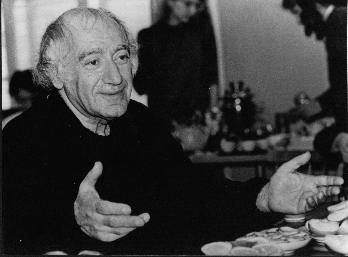
Awet Terterian, Source: terterian.org
His most interesting works are his large-scale compositions, that is to say, his symphonies and stage works. He wrote to operas, "Der Feuerring" and "Das Beben" ("The Earthquake") and eight symphonie. I will focus here on "Das Beben" and his third and sixth symphony, since I know this works best.

Das Beben

"Das Beben" was premiered in 2003 in Munich, at the Theater am Gärtnerplatz by conductor and Terterian-scholar Ekkehard Klemm. It was, originally, commissioned by Edition Peters, in 1984, for a performance in Halle, by that time part of the GDR. The opera calls for a very large orchestra, which wasn't placed on the stage, where the audience was sitting, but in the pit.

The narration, based on the story "Das Erdbeben in Chili" by Heinrich von Kleist. Although the story remains almost incomprehensible, the music is all the more intriguing. Terterian loves to work with repetition, which is a characteristic trait of his music. Dorothea Redepenning, author of the brilliant multi-volume work "History of the Russian and Sowjet Music", assumes vague reminiscences of Armenian folk music, which may or may not be true. In any case, the use of traditional musical elements was encouraged by cultural politics of the communists, but certainly not in the way Terterian employed it. His music is too loud, too long, but on the other hand too reclusive to work as a device for propaganda. For example, a choir is shouting the same words for minutes, while on the stage isn't happening much. There is an uneasy force in this music, not to be compared to minimal music, which I will discuss later.

Unfortunately there is no video footage available of the performance in Munich, but some lucky guys managed to upload some snippets from a perfomance of the Armenian Nation Opera, probably in Erewan.


3. Symphony

A more extreme example are the symphonies, especially the Third. It is marked by the extensive use of percussion instruments and timpani, sometimes beyond the physical capability of the ear. Here, too, Terterian alludes to traditional Armenian music by employing the Zurna and the Duduk, two reed instruments. But again, he is as far away as it gets from using it to allude to Armenian (folk) music. The music is extreme loud, shrill, and acidly, that a willing connection to folk music is suffocated in an instant.

Duduk. Source: Wikimedia
Even when it is not loud and difficult to hear just because of its physical intensity, as in the second of the three movement, the music does not become simply "convinient." In the second movement, a single tone - though not loud - is hold throughout. Nobody has breath enough to hold the tone for almost ten minutes, so the player has to employ special breathing techniques, but it causes the listener physical pain to experience a tone played way beyond the capabilities of human lungs.

Zurna. Quelle: wikimedia

Melody-wise, there is not much happening in the first and third movement. Terterian does not seems interested in melody but rather in building up kind of monumental soundscape (likewise in his Sixth Symphony). His device is repetition, and this puts him in the vicinity of the American minimalist composer.


Nevertheless, I will argue that his music is as far away from minimal music as the music of Morton Feldman is. The aesthetic of minimal music as displayed by Philip Glass or Steve Reich features a dense field of sound in which small changes achieve a strong effect (e. g. "Piano Phase"). It also generates an atmosphere a trance by fast moving patterns and a very characteristic sound color (e. g. "Einstein on the Beach"). In contrary to that, Terterian is not interested in small changes, his music rather accumulates power, but without necessarily discharging it. From the first note, his music is present (as is minimal music, too), but there is still an increasing intensity. His music is not without development, though not in the classical sense.

Terterians music should be played more often in the concert hall, as well as his opera. I guess, it is still looking for the right audience, although there are some performances. The Website http://terterian.org collects performance dates and other interesting information.
Enhanced by Zemanta

Friday, February 14, 2014

...Maurizio Kagel, "Mare nostrum"

I was always a big fan of the music by Maurizio Kagel. I certainly do not know all of his works, but the ones I have listened to so far, have convinced me that Kagel is a composer of the highest rank. Most important for me is his humor which distinguishes him from his peers.

Currently the Wiener Kammeroper is staging a new production of Kagel's chamber opera "Mare nostrum", which translates to "our sea." The opera tells us the story about the colonization of Amazonia, but with swapped roles. The intruders are not men from Europe but natives from the conquered countries, which are going to teach the Europeans their way of civilization.

Kagel limits himself to a very sparse orchestration. He merely uses oboe, flute, cello, and guitar, which are placed on the stage, and percussion and harp, which are offstage. Due to the limitations of the orchestration, the sound is often faint, monophonic and pointillstic, but also strange and exotic. There are also only two actors, one native and one European, which are changing between singing and speaking.

Ben Connor (Amazonian) & Rupert Enticknap (European)
Copyright Armin Bardel
"Mare nostrum" was written in 1975, and it seems to me heavily bound to this time. It breathes the air of post-colonialism and indulges deeply in the guilt of Europeans and what they considered to be "civilizing". Without any doubt, there is an irreparable guilt on part of the Europeans, but would it make an ethical difference if the roles were changed? In my opinion, civilizing other cultures is a crime, notwithstanding who is civilizing by whom. This might be the major flaw of Kagel's work, and he is not the only one falling into this trap.

Hans Werner Henze similarly fall for this idea in "Floß der Medusa", which is also dealing partly with civilizing other cultures, but with a different outcome.
But is an opera really the best way to deal with this part of colonization? Kagel himself, who was Argentine, but spent a lot of time in Europe, might have had an interest in setting the ordeals of his ancestors to music. But there is always the question if the attempt of making these ordeals fitting onto the stage of the opera is rather diminishing them than dignifying.

After the opera, I could not help but notice people complaining about the music. However, I do not share their complaints. Of course, there were no melodies you could sing on your way back home, there were no harmonies you can easily find on the piano. But the music nevertheless had a feeling of wholeness, which I really admire. Kagel seems not to be interested in beautiful sounds. He often employs only one instruments, sometimes only the surface of an object on the stage. The music is tied strongly to the acting, and this inseparability makes it interesting for me.

Ben Connor (Amazonian), Rupert Enticknap (European) &
Members of the Wiener KammerOrchesters. Copyright Armin Bardel

The performance of counter tenor Rupert Enticknap (the European), Ben Connor (the Amazonian) and the instrumentalists was superb. Sometimes I wished they had more opportunity to show their immense and various talents. Especially Connor's delivery of the distorted and meaning-enriched text was impressing. The Wiener Kammeroper is certainly the place for a work like this. But if a work like this is still worth to be performed is another question. The moral implications and the highly visible political ambition is something that does not transport itself easily into our time.

Sunday, February 9, 2014

...Mohammed Fairouz, Symphony No. 4 "In The Shadow Of No Towers"


Yet Another Commemoration Piece?


To be honest, I hadn't very high hopes when I read the first time about Mohammed Fairouz' Symphony No. 4 "In The Shadow Of No Towers" in the review of Grego Applegate Edwards in his Gapplegate Classical-Modern Music Review and also in The Classical Reviewer. That was before I heard a single note of Fairouz' music, and even after a couple of minutes into the first movement I wasn't fully convinced if this Symphony wasn't yet another attempt to catch the latest wave of 9/11 commemoration - since this is a piece which is linked to this very disaster by virtue of its title.

My concerns with this piece where twofold: First, as a composer educated in Europe, I have a certain mistrust against tonal streams in otherwise atonal music, or rather against the intermingling of both. This might be the outcome of a Euro-centric attitude nurtured by overambitious Adorno-reading, that music is only modern if it uses the most advanced material available, which "In The Shadow Of No Towers" does apparently not.

My second concern was, since Fairouz is not the first composer writing a 9/11 commemoration piece, that he also gets trapped in a pitfall John Adams and Steve Reich couldn't avoid. Adams in his "On The Transmigration Of Souls" as well as Reich in "WTC 9/11" both availed themselves with the human voice to transport their message. In both cases this seems to me like the hapless attempt to ensure the "commemoration aptitude" of their music, but it is not more than their average output combined with 9/11-related citations.

This was my inital position for Fairouz' Symphony No. 4.

Something is terribly wrong

Fairouz scored his work for winds, supported by percussions. The movements are (the links point to his Soundcloud channel):

1. The New Normal
2. Notes Of A Heartbroken Narcissist
3. One Nation Under Two Flags
4. Anniversaries

The liner notes as well as the blog mentioned above provide ample information on the titles, and I will not repeat them here. Also the connection to the works of Art Spiegelman, from whom Fairouz borrowed the title, is discussed there at length. Nevertheless, and that be again due to my euro-centric point of view, in my opinion the music must be accessible in one way or another without further explanations. Actually, I don't now the vignettes by Spiegelman very well, and the titles of the movements mean nothing to me, but I expect the music to work for me anyway. And it does.

From the very beginning, there is a disturbing atmosphere in the music, which is refreshingly different to the usual mourning sound à la Adams. Fairouz intention is not to remember the victims of 9/11 but rather to trace the wounds and bruises in the American heart. In fact, it is questionable whether this is a commemoration piece after all. Fairouz often uses grand tonal sounds, for example at the end of the Symphony, but also on various occasions within the piece, but something is always wrong, or rather on the verge of something. Especially the end repeats a certain motive so often that it shifts to its own parody (maybe a reference to Shostakovich's Symphony No. 4). This passage is accompanied by the clicking of two claves, which resembles a ticking clock.


At this point, the question for me was no longer if I can accept tonality, which Fairouz uses plenty of times, but rather for which purpose he employs it. Fairouz is without doubt beyond the quite ideological distinction between tonality or atonality. His music is the result of a multi-stylistic world of music, since he has mastered the comparatively difficult task of combining them. Maybe Fairouz points in the direction music is heading to in the 21st century.
Other composers, like the aforementioned John Adams, miss this point. Adams is merely composing the soundtrack for a commemoration celebration. Fairouz is achieving much more: His music does not illustrate by means of words, it is having a dialogue with its subject through its very own musical symbols.


Mohammed Fairouz' 4th Symphony "In The Shadow Of No Towers" was issued on NAXOS together with Philip Glas' "Concert Fantasy for two Timpani and Orchestra."

Thursday, January 23, 2014

Recently read

Here are a few links to interesting blog articles I read in the last couple of days.

On January 14th Gavin Plumley wrote in his blog ENTARTETE MUSIK about the connections between Beethoven, Mahler, and Shostakovich. I bookmarked this partly because of the class I am teaching next semester on symphonies of the 20th century.

Symphonic Connections


I already posted a link on Facebook to an interview with the Australian Composer Madeleine Cocolas by Dana Wen, which was published on I CARE IF YOU LISTEN, also on January 14. Ms. Cocolas is writing a composition every week due to reasons explained in the interview. There is a link to her music on Soundcloud, too. I have not decided what to think about this project, yet, but I like the music anyway.

5 questions to Madeleine Cocolas (composer) 


James Jordan is contemplating in his blog Musical America about the will of the composer and his influence on future performances, especially of stage works. In his posts he questions the value of comments of composers about their works in letters, theoretical papers and talks for the interpretation.

Want not